
Automotive bonding applications
Within the automotive industry, induction heating of panels is currently the primary method of choice for pre-curing adhesives and sealers for automotive closure components. With the need of high production rate, the process of induction curing has been able to meet or exceed the production requirements of the industry.
Induction accelerated bonding today
The use of adhesives in the automotive industry is becoming more prevalent, every new model seems to have more bonded joints than its predecessor. It’s not difficult to see why this is happening; the benefits of using adhesives to replace more traditional techniques are well documented, and modern day engineers are more prepared to use adhesives than their predecessors.
However, one major factor in the selection and suitability of adhesives is the cure time, in many production environments, an adhesive with a suitably wide “open time” for real world usage will not reach a realistic level of strength within the production cycle and therefore, many bonded joints also incorporate immediate “mechanical” joints such as welds or rivets to maintain the product geometry until the adhesive has cured either by it’s own chemical reaction or after spending 30 or so minutes in a paint oven.
One particular bonded joint used in car production that has been developed to the stage where mechanical joining techniques can be eradicated is that of the hemmed edge of many closure panels i.e. doors, hoods, and tailgates. The adhesive in these joints can be pre-cured by locally heating the hem to achieve enough strength to enable hanging and fitting of the panel, the full strength is not achieved until after the paint oven process.
The use of induction heating equipment to pre-cure hem adhesives and sealants has been used with varying success for over 20 years and we at ENRX have been at the forefront of industry developments from the beginning. This article will briefly describe the history of hem-bonding and list some of the problems experienced with earlier processes, and describe how the technology has developed in recent years to not only make the process more robust but to bring much increased flexibility and cost saving to the process.
Furthermore, it will touch on some of the latest ideas that are currently being developed and perhaps spark some ideas for the next generation of bonded joints. Induction heating is particularly well suited to bonding applications because it is safe, infinitely controllable and compact, and can be integrated into most processes quite invisibly. Remember that all electrically conductive material can be heated with a cold heating element (Coil) and high efficiency. In recent years, accelerated curing using induction heating has been introduced to industries as diverse as automotive, appliance and golf club manufacturing.

Universal fixture for lab/process trials on customer panels. In this case a steel hood is being heated using the Full-Ring method.
As an example we can take the automotive Body-in-White manufacturing industry:
In the early 1980’s ENRX companies became involved in pre-curing adhesives in hemmed closure panel assemblies in the automotive industry.
Early equipment used “single-turn” ring coils, which heated the whole perimeter of the panel. These coils were typically made of square or rectangular section copper tube and were painstakingly manufactured to fit each panel type (See Fig.1). The technology was young and although initially impressed by the strength and other advantages of the process i.e. no welds to “clean”, thinner substrates, increased joint strength etc, engineers soon began asking if the distortion element could be improved. Since that time in response to these questions, ENRX has had a laboratory dedicated to bonding development, ENRX developed the Spot-Bonding®process and patented the application; continued development has resulted in the Spot-Bonding concept that EFD Induction recommend today. “The Lab” has been fundamentalto the evolution of the process; new car programmes are not daily events and the opportunity to trial & evaluate new process technology in real-world situations is limited. The Lab cannot simulate the whole production line, but it can provide an excellent simulation of real-world curing. It’s not uncommon to see customer-supplied racks of assembled doors or hoods for trial purposes being delivered. Customers supply panels “FOC” for Lab trials for a specific project or for general evaluation of new adhesive/tool/coil configurations or data-acquisition packages for instance. Continuous development over 20 years has led to the current state-of-the-art coil configuration: the U-Coil (patented). This type of coil (and its unique associated tooling) has shown vast improvements in strength and distortion over any other coil type ever tried in The Lab.

Fig. 1 – Edge-Coil system

Fig. 2 – U-Coil system

Fig. 3 - 100mm U-Coil in compliance head
Due to the lessened distortion by heating both sides of the joint (see Fig. 4) and the fact the coils “follow” the panel if there is any movement during heating – no clamps are required to keep the coil to panel relationship constant.
The advantages of using the U-Coil are continually being discovered; the significant increase in bond performance has enabled less “spots” to be cured to achieve the required assembly strength. For instance, a recent executive saloon with aluminium doors is being heated in 100mm long spots in three places along the bottom edge and one at the waist rail in the window area. Trials made using a hand-held U-Coil proved that the assembly was stiff enough to maintain dimensional stability during the hanging process even with such a minimal approach. The advantages can be listed in purely financial terms due to the decreased cost associated with less equipment, a smaller induction generator and cooling equipment plus the lower use of energy required to power the system. Other advantages would be that the assembly cools more rapidly, reduced fume from the adhesive and much reduced risk of deformation during heating, which is often seen in aluminium assemblies.
One area that is being exploited currently is the flexibility and the realisation that these coils can be utilised in new areas of a production cell. For instance the doors mentioned above are being cured in the output conveyor not in a traditional table type tool (See Fig.5). The reduced cost of the tooling and floor space adds to the advantages already listed.

Fig. 4 - Induction field with U-Coil

Fig. 5 - U-Coils fitted into output conveyor
Another situation has arrived since the advent of roller-hemming of lower volume assemblies. A U-Coil can be mounted on the robot arm to be moved from spot to spot after the hemming operation or, the robot takes the panel to a pedestal mounted U-Coil in much the same way as it would to a static spotwelder (See Fig. 6).
Chart 1. Shows temperature inside the joint where the outer panel skin temperature is 177°C. The edge coil reading shows that the bondline temperature is approx. 121°C, whereas, with the U-Coil, readings are within 3° of the skin temperature. This is at the crucial early
stage of the heating cycle.
The curves are almost identical so there is no sign of the S-Coil bondline temperature “catching up”. These figures suggest that to achieve 177°C at the bondline with the
edge coil – the skin temperature would need to be 230°C.

Fig. 6 – U-Coil in roller-hemming cell

Chart 1. Temperature differential

Fig. 7 - Induction field with S-Coil
Chart 2. Shows shear strengths achieved using a One-Part Epoxy at various skin temperatures. These temperatures are higher than are normally used in Europe (faster cycle times in US) but are representative. N.B. The “S-Coil” is a single-turn edge heating coil as shown in Fig. 7.
Edge heating S-Coils are still used for certain applications for instance, panels that need full perimeter (full-ring) heating because over-hem sealer is being applied robotically in the curing station sometimes use edge coils – however, distortion is a factor.
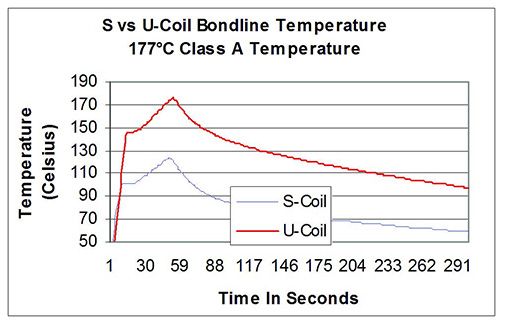
Chart 2. Strength differential
Two-turn flex-coils
Actually, it’s common nowadays to use a two-turn full perimeter coil as shown in Fig. 8, which allows a more flexible approach than the old style edge coils. The field is more homogeneous, more forgiving and allows some variation in panel position. Contemporary full-ring systems mostly use two-turn, flexible coils. These coils comprise of a braided inductor housed within high-temperature, flexible hose. The hose acts as an insulator and the cooling water (necessary for most induction coils) flows within the hose. As well as offering the most robust full-ring heating process, these coils offer other advantages over the older style copper coils in that they are offered in standard lengths and due to their flexibility can be fitted to almost any panel shape. Part-specific coils are more costly to manufacture and keep as spares.

Fig. 8 - Two-turn flex-coil

Fig. 9 - Induction field with two-turn flex-coil
Steel vs. aluminium
Both spot and full-ring systems are used for heating steel and aluminium assemblies; however, there are some factors that need to be considered when thinking about aluminium heating.
- Aluminium is non-magnetic and requires more power to heat than the same component in steel.
- Aluminium conducts heat faster than steel.
- Aluminium expands more than steel during heating
Key to 1
Aluminium does need more power to its electrical properties and overcome not only the non-magnetism but also because the heat is conducting away from the heated zone faster than with steel. However, this does not necessarily mean that a larger powered induction generator is required, the same power equipment can be used but it takes a little longer. For instance, a typical European U-Coil spot-bonding application on steel would use a 25kW generator and be set to ramp up to cure temperature circa 170°C in 5 seconds. However, the 5-second figure is chosen because it’s quite “slow” and is less prone to distortion inducement and less affected by condition changes such as adhesive quantity and/or position. In fact, the generator might only be using 50 – 60% of it’s capability to reach that temperature in 5 seconds, in extremely fast production cycles it’s not uncommon to ramp up to target temperature in 1 – 2 seconds. If we also consider that many aluminium processes use adhesives that require lower temperatures i.e. 120 - 150°C, we can still ramp in 5 seconds using the same equipment, which when most aluminium processes are for lower volume vehicles should not be an issue.
There are some cases where full-ring heating of aluminium assemblies has been required and in this case the difference is more noticeable, a full-ring system requires more power because of the larger mass of metal to be heated and the fact that the full-ring coils are not as efficient as the U-Coil. In the case that a 25kW generator is used the ramp time for a typical steel panel might be 5 seconds using 100% power, but the corresponding part in aluminium might take 12 seconds or more to reach the same temperature. Of course, larger powered equipment is available should the need arise but in most cases these times are fast enough.
Key to 2
Aluminium conducts heat faster than steel, which can be both an advantage and disadvantage. The advantages are that more homogeneous heating can be achieved throughout a joint faster than with steel and the heated zone will cool more quickly the disadvantages are that more power is required to maintain temperature (see above) and that the heated zone is wider.
Key to 3
Aluminium does expand more than steel and in the case of a hemmed panel this manifests itself as distortion. There seems to be two schools of thought on how best to tackle this issue. The first is to place the assembly in a substantial nest and use many heavy-duty clamps to hold the hem edge in shape. The problem with this approach is that the metal has to expand somewhere and very often the distortion can be seen as creases or dents in other areas inboard of the hem. Also, stress is compounded by concentration, which sometimes is not apparent until after the paint oven process,which has the effect of softening the adhesive enough for stress relieving to cause more distortion.
The second approach is to support the panel on a much reduced nest without clamps and allow the assembly to move freely during the heating stage to avoid unnecessary stress buildup, The key to this approach is how the adhesive performs i.e. an adhesive that builds up high strength quickly and/or at higher temperatures can lock the panel in the distorted shape which can introduce stress. Whereas an adhesive that begins to cure but doesn’t build such high strength so quickly, or at least until the panel has cooled to 40 - 60° (after 30 seconds or so) will allow the panel to return to its natural “cold” condition before locking the geometry. Onemethod of tackling fast reaction adhesives is to increase ramp time so the target cure temperature is not reached so quickly i.e. 30 seconds or more. This widens the heated zone, which lessens the local distortion in the bonded area.
For all the reasons above, and more, Spot-Bonding with U-Coils with a progressive adhesive is by far the best way we have found to process aluminium assemblies. In fact, this methodmeans that aluminium should be no more problematic than steel. However, full-ring curing is not ruled out as an industrialised process, just that more care is required.
Current developments
Focus on new process development is usually prompted by OEM’s and is somewhat reactive i.e. OEM discovers a problem with a new process and a solution is found to fix that particular problem. However, such missions to improve an existing process often throw up new opportunities, which lead to further research into possibilities to enhance production processes. For instance, findings during a recent project to improve the production process for a large volume European car has led to the current research program between ENRX, a prominent adhesives supplier and a luxury vehicle manufacturer with the view to absorbing component tolerances in low to medium volume assembly cells. Using data gathered during the problem-solving exercise we were able to demonstrate certain capabilities that are proving very interesting and we are now gathering data to bring this new process into fruition.